Build behavioural thinking into the work your team already does.
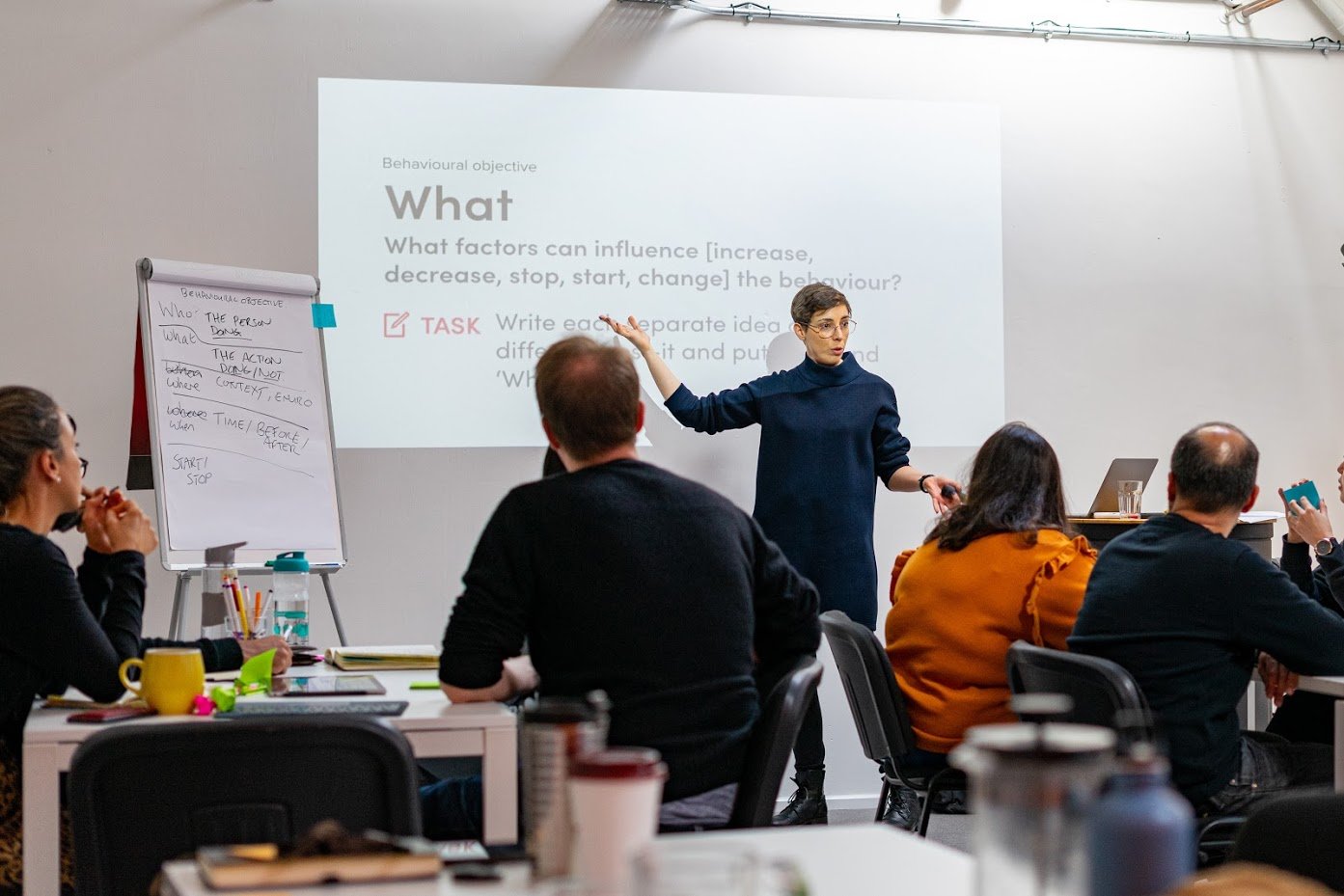
Teams rarely need another inspiring training day. They need better calls on the next live decision: the review, the launch gate, the plan that quietly depends on people acting differently. We build Behaviour Thinking into the places where those decisions already happen.
Across 13 cohorts of our longest-running programme, 93% of learners were applying the tools within 30 days.
Start the conversationWho this is for
Teams who keep meeting the same behavioural problem in different clothes: the product team asking, again, why people are not adopting; the change team told, again, that staff just need training; the leadership team approving, again, a plan that depends on behaviour nobody has tested.
One weak project is bad luck. The same blindspot across five is a missing capability.
What your team becomes able to do
Behavioural Fit.
Leaders who can name the behaviour a plan is betting on and make the call: proceed, test, redesign, stop.
Behavioural Design.
Practitioners who can define a behaviour, diagnose what is shaping it, and design and test the route. The work behind our university courses and the six-week intensive on strategic behavioural design.
Behavioural Infrastructure.
Review rituals, decision standards, internal champions and trainers, so the judgement survives staff churn and the end of the project.
Training fades because nothing in the week asks anyone to use it. The launch gate asks about budget and delivery, never about what people must do. So we build the judgement into meetings that already exist, with the tools to hand and the permission to use them.
The training was fine. The organisation never gave it a job. Ours arrives with one.
How it is shaped
Every engagement is shaped around the team: training, leadership sessions, BehaviourKit deployment, coaching on live work, playbooks, decision standards, train-the-trainer. The mix follows one question: what does this team need to judge without waiting for someone outside the room?
The record
Over 250 professionals trained across 13 cohorts, with learners from Nike, IKEA and Netflix. Three universities teach behavioural design on courses we built: Hyper Island, Politecnico di Milano and Manchester Metropolitan. PwC’s change team took confidence in working with behaviour from 21% to 70%. Accenture’s design team at The Dock trained with us over two years. Estonian ministries learned a one-day behaviour sprint they run themselves. D&AD’s trainers deliver with a system we built for them.
“Some of the best training we’ve had as a team. A highly popular training series with valuable tools the team now uses.”
Cliodhna Maxwell, Accenture
When this is the wrong page
One project, one exposed decision? Start with a Behavioural Fit Session. Live work, and people are not acting? BehaviourKit. Early idea, no budget attached? Run the canvas.
Capability is for when the same questions keep returning, and the team has nowhere to keep its own judgement.
How to start
Three things, no long brief. The first reply proposes a conversation, never a proposal.
Not on this path yet?