
Every plan needs somebody to do something. This is where you work out what.
Two days to name the behaviour. Five to start changing it.
By Friday you'll know whether what your plan assumes about people is likely.
Book two daysYour plan rests on a belief about a person.
That they'll notice the prompt. That they'll want to. That they'll know how. That the moment you designed for is a moment they're actually in.
Somewhere in there is one belief the whole thing depends on, and nobody has checked it.
We find it. Then we go and check it.
Reframe
You arrive with the problem in the words your team uses. Nothing cleaned up. The answer is usually already in the building, held in pieces by people who have never been asked to put it in one place. What the front line hears. What the field team sees. What the data has been saying. What's been tried, and what happened to it.
We work through it, and we narrow, until there is one behaviour, in one sentence, that somebody could go and watch happen tomorrow.
You leave with the Framing Brief. The behavioural problem statement, the assumptions inside it named with owners and dates, and the number that decides everything else: how many behaviours you actually have.
Most people arrive with four and believe they have one.
£4,800 · Two days · Fixed

Reframe decides what you buy next
That's a sprint.
That's a partnership. Months, one at a time, in order.
Sometimes the real bottleneck is a resource constraint, a policy, or something well outside your organisation. If that's what we find, we'll say so, and there's nothing more to buy.
Nobody has ever been sold less behaviour change than they asked for. We can do it because the two days actually produce the answer.

The sprint
Five days, or two weeks spread across the diary. One behaviour.
Map it.
The behaviour, step by step. What the person is doing, what they're thinking, and where it breaks. Most of this is already known. It has rarely been drawn.
Diagnose it.
Why it breaks. Is it the person, the people around them, or the system they're in? Most things that look like motivation problems turn out to be context problems.
Design against it.
The barrier points to a pathway: is this behaviour being started, stopped, evolved, realigned, or fine-tuned? The pathway points to moves that have worked on that shape of problem before.
You pick from things with a mechanism behind them, and you write the hypothesis down before you build anything.
If we do this, then these people will do that, because of this.
Then we find the word in that sentence nobody has ever checked.
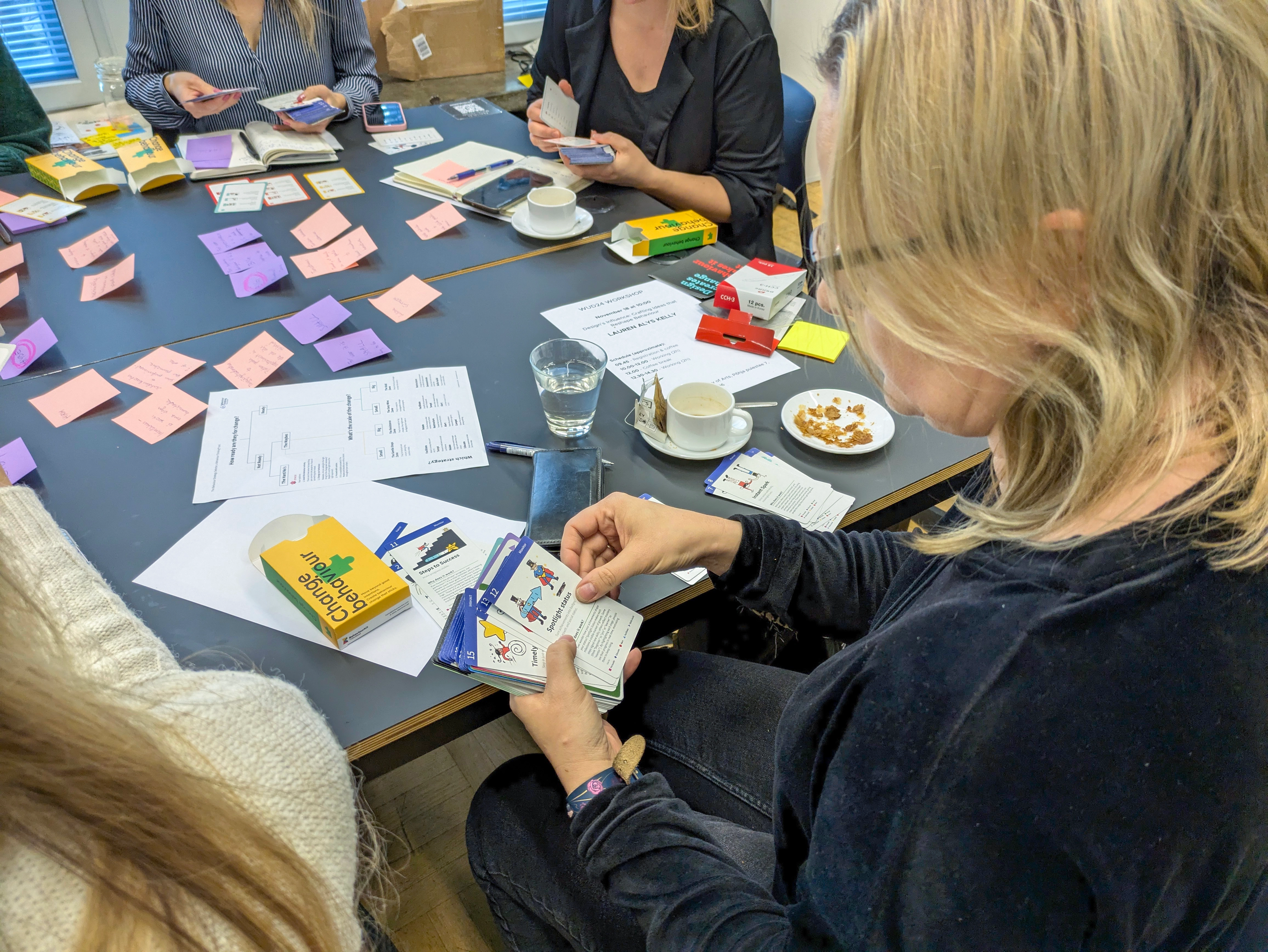
Build something that tests it.
Paper, a script, a rough prototype. Enough to put in front of a person and find out whether the belief holds.
Put it in front of people and find out what's true.
Four people. Twenty minutes each.
Day five
We're not asking whether they like the idea. We're finding out whether what your plan believes about them holds up.
Do you know where your meter is? Somebody says no. That's a plan changed on a Friday, for the price of a week.
Twenty minutes is enough for that. It isn't enough to prove a behaviour will hold for six months, and we won't pretend otherwise.
We kill assumptions. We don't certify success.
Then, in the afternoon
If the assumption held
We write down what you'll watch for once it's live, what it means when it moves, what you'll do about it, and who owns that. The Behaviour Change Account. It's what keeps the work alive after everyone goes back to their inbox.
If it didn't
That's the more valuable Friday, and it's the one you're paying for. We work out what's actually true instead, correct the hypothesis, and you leave knowing what the plan has to change.
What you have on Friday
The behaviour, named.
What's holding it in place.
A designed intervention, with the reasoning written next to it.
The belief the plan was resting on, and whether it survived four real people.
A decision, with an owner.
And, if it held, the Account that tells you what to watch.
What it costs
Two days. Fixed.
£4,800
One behaviour. Five days intensive at the bottom. Two weeks spread, with fieldwork between sessions, at the top.
£14,000 – £24,000
Sprints in sequence, over months, each one feeding the next. Scoped from what Reframe found, not from what we hoped to sell you.
Quoted after Reframe
Reframe tells us which you need, so we quote the sprint after it rather than before. A rollout built on an assumption nobody checked costs considerably more than a fortnight.
Behavioural partnership
Some problems are four behaviours pretending to be one. A rollout across sixty stores. AI adoption across a consultancy. A service redesign that touches three different people doing three different things.
Running a single sprint at that gets you a very confident answer to a quarter of the question.
A partnership is sprints in sequence, over months, each one feeding the next. Scoped from what Reframe found, not from what we hoped to sell you.
The kitchen
A health app was losing patients at exactly three weeks. The team had diagnosed a feature problem, and were building features.
The behaviour was happening in kitchens, with family, in the evening, nowhere near a screen.
The roadmap changed.
Elsewhere: six ministries of the Estonian Government, one day each. Seven weeks with Infosys Consulting on AI adoption. Ten high-growth startups with the World Economic Forum and Accenture.

What you're probably thinking
We've already done the research.
Usually there's plenty. It's in three different teams and it has never been in one room.
We already know what the problem is.
Most people do. Most of them are describing an outcome. Engagement is not something a person does.
We haven't got three weeks.
Reframe is two days. Estonia was one.
It's too late. We've already committed.
Then the question isn't whether the plan changes. It's whether you find out now, or in six months.
What we need from you
Five to seven people, for two days. A decision-maker among them, and at least one person who talks to your customers every day.
Whatever you already have: analytics, research, complaints, what's been tried before.
Access to four people the behaviour belongs to, for the Friday.
And a plan you're still willing to change. If it's locked, don't do this.
We work in your building, in ours, or remotely. All three work, as long as we can reach the people the behaviour belongs to.

Start with the two days.
£4,800. Pick a date and we'll send the pre-work. We're usually booking four to six weeks out. You'll leave with the behaviour named, the assumptions listed, and an honest answer about what happens next.
Book two daysNot ready to book? Test Before You Scale — how to stop good-sounding ideas becoming expensive ones.
Want to run this yourselves? Build the capability — the same method, as a product your team facilitates.